1. Overview
Cloaks & Dagger is a hidden-position survival game built around incomplete information. Players attack opponents while avoiding being targeted themselves, inferring positions from footprints, attack history, decoys, recharge-room behavior, item use, and trait-based powers.
The backend acts as the game master: clients submit intent, while the server owns the full room state and resolves the outcome. This keeps hidden positions and combat state from being exposed or fabricated by a browser, while still letting the client animate quickly and reconcile after position, resources, and combat are finalized.
Loop structure
The gameplay loop starts with room registration, then repeats through observation, player intent, server resolution, and client reconciliation until the room ends.
| Stage | Current structure |
|---|---|
| Registration | Selected Cloaks enter the room roster, up to the per-player limit. |
| Start threshold | The room starts when the required player count is reached. |
| Spawn | Cloaks spawn with metadata-derived vitals and abilities. |
| Visible state | Local board state, self state, visible items, clues, marks, decoys, presence signals, and live events. |
| Hidden state | Opponent positions and unresolved combat state stay server-owned. |
| Player intent | Move, queued movement, attack a tile, or use an item. |
| Validation | Rejects stale, invalid, unaffordable, blocked, or out-of-range actions. |
| Resolution | Applies the accepted action and writes the resulting room state. |
| Reconciliation | Optimistic movement, animation, and UI state reconcile to the server result. |
| Room lifecycle | Ends when time runs out or only one player's Cloak(s) remain. |
2. Gameplay Rule System
*subject to change
The game logic is designed so each token's metadata can lead to different strategies. These examples show how several current rules connect metadata, hidden-state play, and board interaction.
| Metadata / item input | Rule or move | Current behavior |
|---|---|---|
| Cheetah Type | Stamina recovery | Recovers stamina faster than the normal stamina refresh rate. |
| Bat Type | Footprint suppression / Guano Bomb | Suppresses normal movement footprints and can use a Bat-specific area attack. |
| Potion of Invisibility | Stealth | Suppresses footprints and sight-based reveals; correct-tile attacks can still land. |
| Potion of Telekinesis | Reveal | Temporarily reveals exact nearby presence markers. |
| Potion of Summoning | Decoys | Adds decoy charges; placed decoys create false presence until attacked. |
| Clan | Recharge-room access | Matching clans enter; foreign clans are denied; clanless Cloaks use a remembered room decision. |
| Komodo Type | Komodo Pit | Creates a poison source that damages entrants over time while allowing movement. |
| Viper / Python Animal Wrap | Snake Pit | Creates an immobilizing trap zone for non-immune Cloaks. |
| Key of Secrets | Secret interaction | It's a secret, migo. |
| Halo | Lethal block | Blocks one lethal hit per room session, then is consumed for that session. |
| Sword of the Moon / Earth / Fire / Sun | Sword area attack | Uses a sword-specific area size, from smaller Moon coverage to larger Sun coverage. |
Defensive behavior
Armor-style metadata traits map to a specific chance to block an incoming attack. When the block succeeds, the Cloak receives no damage from that attack.
Armor block rates use both item naming and rarity. Each armor family has its own defensive band, then rarity within that family determines the final rate. This keeps stronger-sounding armor meaningful without making global rarity the only balance input.
| Armor family | Trait class | Block-rate band |
|---|---|---|
| Chestplate | Chest | 18%-30% |
| Elite Guard | Chest | 16%-30% |
| Battle Vest | Chest | 14%-25% |
| Vest | Chest | 10%-20% |
| Shoulder Armor | Shoulder Gear | 12%-30% |
| Shoulder Guard | Shoulder Gear | 10%-20% |
| Single Guard | Shoulder Gear | 20%-30% |
| Strap | Shoulder Gear | 5%-10% |
The full table below is sorted by highest block rate, then alphabetically for items with the same rate.
| Armor item | Trait class | Quantity | Block rate |
|---|---|---|---|
| Chestplate Samurai Moon | Chest | 177 | 30% |
| Elite Guard Red | Chest | 135 | 30% |
| Shoulder Armor Spikes | Shoulder Gear | 54 | 30% |
| Single Guard Silver | Shoulder Gear | 49 | 30% |
| Shoulder Armor Gold | Shoulder Gear | 71 | 29% |
| Chestplate Titanium | Chest | 325 | 28% |
| Chestplate Gold | Chest | 446 | 27% |
| Elite Guard Silver | Chest | 199 | 26% |
| Single Guard Gold | Shoulder Gear | 124 | 26% |
| Battle Vest Red | Chest | 121 | 25% |
| Chestplate Samurai Dusk | Chest | 720 | 24% |
| Chestplate Samurai | Chest | 821 | 23% |
| Shoulder Guard Emerald | Shoulder Gear | 305 | 20% |
| Single Guard Steel | Shoulder Gear | 243 | 20% |
| Vest Regal Guard | Chest | 178 | 20% |
| Battle Vest Brown | Chest | 279 | 19% |
| Chestplate Steel | Chest | 1123 | 19% |
| Shoulder Armor Silver | Shoulder Gear | 285 | 19% |
| Chestplate Iron | Chest | 1224 | 18% |
| Vest Blue | Chest | 229 | 18% |
| Vest Red Guard | Chest | 231 | 18% |
| Vest Silver | Chest | 251 | 17% |
| Elite Guard Bronze | Chest | 339 | 16% |
| Shoulder Guard Ruby | Shoulder Gear | 450 | 16% |
| Battle Vest Tan | Chest | 395 | 14% |
| Shoulder Armor Steel | Shoulder Gear | 437 | 12% |
| Shoulder Guard Topaz | Shoulder Gear | 698 | 10% |
| Strap X Red | Chest | 143 | 10% |
| Vest Brown Guard | Chest | 401 | 10% |
| Strap Grey Left | Chest | 283 | 9% |
| Strap Grey Right | Chest | 302 | 8% |
| Strap X Grey | Chest | 459 | 7% |
| Strap Black | Chest | 592 | 5% |
| Strap X Brown | Chest | 625 | 5% |
When a Cloak has more than one defensive armor trait, block rates combine multiplicatively. This gives diminishing returns instead of summing the rates.
# CLOAKS #27 has Chestplate Samurai Moon and Shoulder Armor Steel.
# Chestplate Samurai Moon -> 30% block.
# Shoulder Armor Steel -> 12% block.

combined_block = 1 - ((1 - 0.30) * (1 - 0.12))
combined_block = 0.384 # 38.4%, not 42%
Vitals
Vitals come from the three numeric metadata traits: Power/Strength sets HP, Wisdom/Magic sets PP, and Speed/Agility sets Stamina.
# Power -> HP, Wisdom -> PP, Speed -> Stamina.
# Example: CLOAKS #12432 has Power/Strength=98,
# Wisdom/Magic=97, and Speed/Agility=94.
# With HP_BASE=50, HP_MIN=1, HP_CAP=125: max_hp = clamp(98 + 50, 1, 125) = 125.

max_hp      = _clamp(power + 50, 1, 125) # range: 51-125 HP
max_pp      = _clamp(int(25 + ((wisdom - 1) / 98.0) * 25.0), 1, 50) # range: 25-50 PP
max_stamina = _clamp(speed + 50, 1, 150) # range: 51-149 Stamina
Information mechanics
Players read clues about where opponents may be; exact positions are shown only in specific cases such as same-tile presence or reveal effects.
| Mechanic | Information it gives |
|---|---|
| Footprints | Shows a recently left tile, fading by movement step age and using clan color when available. |
| Attack marks | Shows the attacker whether a targeted tile missed, hit, or was blocked. |
| Directional clues | Summarizes nearby presence by direction without token IDs or exact coordinates. |
| Foreign / familiar clues | Indicates whether nearby presence is from the same clan or not. |
Special tiles
Mystery tiles let players pull found items during a room. Drops can include stat replenishers, swords, potions, and other metadata item types, with rarity tied to drop rate.
Found items are separate from a Cloak's own metadata traits. A Cloak can always use its metadata item or ability when it has enough PP; mystery tiles add temporary room items through exploration.
Recharge rooms are tied to clan territory. A Cloak can enter the recharge room matching its clan, while Cloaks from other clans are blocked from that room.
For clanless Cloaks, entry is resolved per recharge room and remembered for that room for the rest of the game.
3. Eligibility And Access
Cloaks & Dagger is holder-gated. Players need to own at least one Cloak to enter a room, and wallet verification is handled through Privy.
A player can connect multiple wallets to one account, including wallet delegate support. Eligible Cloaks can then be registered into live rooms where holders play against each other in real time.
| Area | How it works |
|---|---|
| Player account | One account can collect eligible Cloaks across connected wallets. |
| Wallet verification | Privy verifies wallet login and ownership. |
| Holder gate | A verified Cloak is required to enter gameplay. |
| Game registration | Players choose which eligible Cloaks to register for the current room. |
| Live rooms | Registered holders play against each other in real time. |
A Cloak can only be registered in one active game at a time. It must be eliminated or survive the room before it can enter another game.
4. Board Design
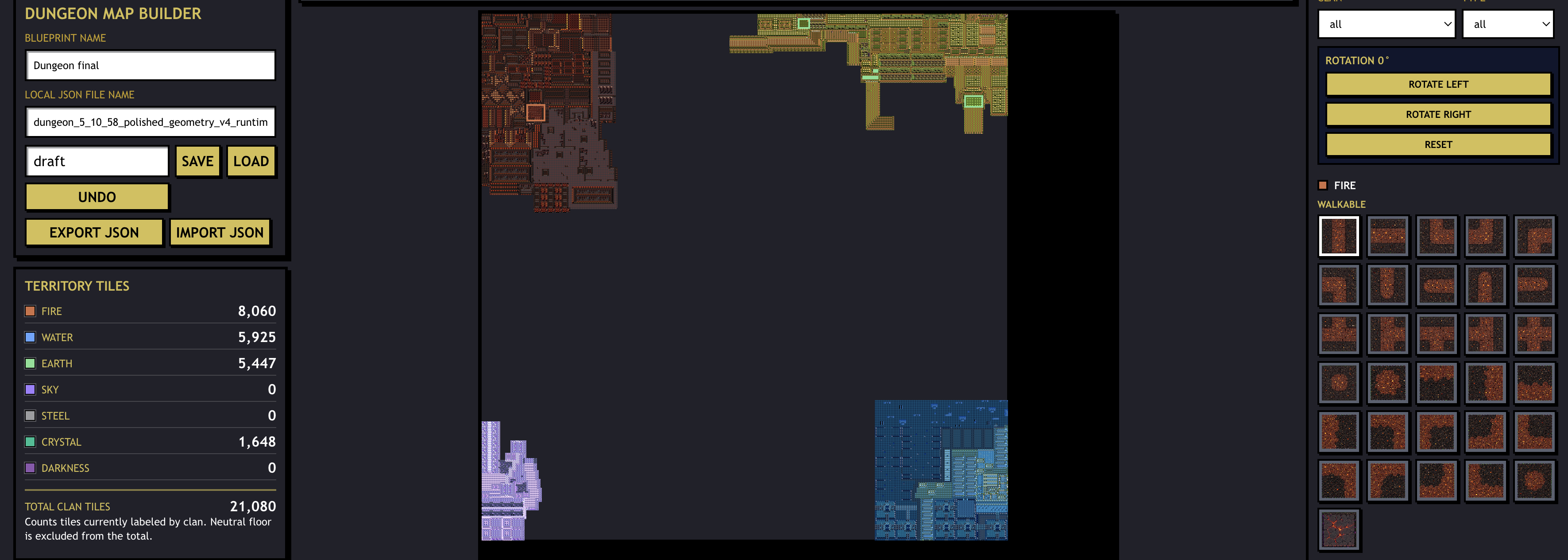
The game takes place on a classic RPG grid board. The Season 1 map is a custom-built arena with seven clan regions, distinct regional styling, and authored walkable and blocked tiles.
5. Architecture
The runtime is split into a canonical game layer, a browser presentation layer, authored board data, and lightweight update paths. This keeps gameplay rules centralized while allowing the client to stay responsive.
| Layer | Current structure |
|---|---|
| Game core | Django/DRF owns room state, action validation, movement writes, item effects, combat, elimination, and visibility rules. |
| Client layer | React/Vite renders the viewport, local controls, animation, and queued movement feedback from server-confirmed state. |
| Map | The authored map is imported once into the backend runtime coordinate model. |
| Update path | Clients receive compact room state, presence, and live events without exposing hidden opponent state. |
| Concurrency | Movement uses locked authoritative writes to prevent race conditions, burst movement, and teleport-style state drift. |
| Scaling | Hot state is kept compact, timed, and separated from larger static board payloads. |
6. Work In Progress
- Visuals: Cloak sprites and Season 1 map design.
- Backend: Logic edge-case hardening, performance refactoring, and game rules.
- Testing: Testbench coverage, regression checks, security leakage audits, and staging instrumentation for slow-path timing during playtests.
- Planned: XP system, leaderboard design, and player profiles. Not started yet.
- Potential feature: Contract-based room and result tracking for public analysis tooling.